
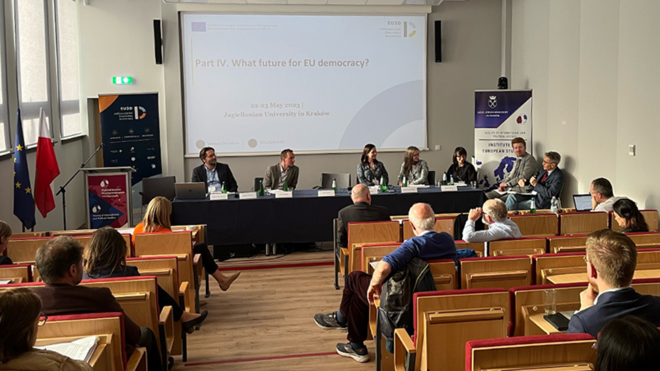
The concluding conference of EU3D was held in Krakow on 22 and 23 May 2023. It gathered researchers from the project and external guests to discuss the topic ‘What future for European democracy? Differentiation, dominance, and possible EU trajectories’.
Summing up main findings
The first day of the concluding conference was devoted to summing up, synthetising and reflecting on the main project findings since the project started up in 2019.
“The topic that we chose long ago, turned out to be particularly timely and relevant. And as time goes by, differentiation, dominance, democracy are becoming more and more relevant,” said professor Zdzisław Mach, head of the Jagiellonian EU3D team, during the opening session of the conference.
He added that the rise of populist regimes in Europe makes the question of democracy particularly relevant, and shows how diverse the EU can be, while still being integrated.
EU3D scientific coordinator John Erik Fossum highlighted that one important part of EU3D was to bring together theory and empirics and that this is fundamental to a project - especially at times of significant transformation.
Fossum said that doing research during a pandemic meant the project had to shift its focus slightly, and instead of simply tracing processes, researchers were also “process chasing” ongoing developments in Europe.
“Since the beginning of the project the EU has changed and there is a whole tapestry of new dynamics. To be able to track that is a significant challenge,” said Fossum.
The opening session was followed by panel debates on the following topics:
- Conceptual clarifications. Differentiation and dominance reconsidered
- Internal and external challenges: differentiation and dominance
- Citizens’ views on reforms of democracy in the EU
- What future for EU democracy?
Recordings of each session are available here or by clicking each panel title.
Challenges to democracy
Klaus Welle, former Secretary General of the European Parliament, Visiting Professor at KU Leuven and Guest Professor in Practice at LSE, started the second day with a keynote speech on challenges to democracy.
Welle presented two types of challenges to the democratic functioning of the EU. The types of challenge are linked to the organisation of the EU system as a division of power system.
“These challenges are system inherent, will not go away and are not pathological,” said Welle.
The second type of challenge to European democracy are challenges that arise from malfunctioning of the system.
“These challenges can lie at the institutional level, can be linked to the interplay of different institutions or can be linked to challenges with the system overall. These challenges to democracy can also come from external sources.”

The speech was followed by a panel discussion on prospects of European democracy with Brigid Laffan, Emeritus Professor at the European University Institute, Albena Azmanova, Professor of Political and Social Science, University of Kent, and Adam Jasser, Deputy editor, Visegrad Insight and Res Publica Nowa.
Two other panels were also held on Tuesday 23 May:
'Populist and sovereignist threat to the EU. New trajectory for the EU?' with Jonathan White, Deputy Head of the European Institute and Professor of Politics, LSE, Natasza Styczyńska, Assistant professor, Jagiellonian University, EU3D and Sergio Fabbrini, Professor of Political Science and International Relations, LUISS, EU3D. Chaired by Zdzisław Mach, Professor in Sociology and Anthropology, Jagiellonian University, EU3D.
And 'External threats to European democracy' with Joanna Skoczek, Deputy Permanent Representation of the Republic of Poland to the United Nations, New York, Marzenna Guz-Vetter, Head of the Representation of the Commission in Warsaw, Emilian Kavalsky, Professor of International Relations, Jagiellonian University, and Matteo Bonomi, Senior Fellow in the “EU, politics and institutions” programme at Istituto Affari Internazionali. Chaired by Sabine Saurugger, Director of Sciences Po Grenoble, EU3D.
Concluding a four-year project
The conference was held and organised by the EU3D partner Jagiellonian University in Krakow, in cooperation with ARENA Centre for European Studies at the University of Oslo.
EU Differentiation, Dominance and Democracy (EU3D) is a four-year EU-funded project. EU3D set out to specify the conditions under which differentiation is politically acceptable, institutionally sustainable, and democratically legitimate. Equally important, EU3D specifies the conditions under which it is not, in other words when conditions of dominance prevail.
The project brings together around 50 researchers from 10 European countries and is concluded on 31 July 2023.
